Businesses
Businesses
Health Plans for Businesses
- Overview
- Global Health Solutions for SMEs and Large Corporates
General
- Why Cigna Middle East
- Blog
- Contact US
Businesses
Businesses
Health Plans for Businesses
- Overview
- Global Health Solutions for SMEs and Large Corporates
General
- Why Cigna Middle East
- Blog
- Contact Us
Businesses
Health Plans for Businesses
- Overview
- Global Health Solutions for SMEs and Large Corporates
General
- Why Cigna Middle East
- Blog
- Contact Us
Businesses
Health Plans for Businesses
- Overview
- Global Health Solutions for SMEs and Large Corporates
General
- Why Cigna Middle East
- Blog
- Contact Us
Businesses
Health Plans for Businesses
- Overview
- Global Health Solutions for SMEs and Large Corporates
General
- Why Cigna Middle East
- Blog
- Contact Us
Government
Health Plans for Governments
- Overview
- Plans & Services
General
- Why Cigna Middle East
- Blog
- Contact Us
Individuals and Families
Health Plans for Individuals and Families
- Overview
- Comprehensive Health Solutions for Individuals
- Basic Mandated Health Solutions for Individuals
General
- Why Cigna Middle East
- Blog
- Contact Us
About Cigna Middle East
- Corporate Profile
- Cigna Insurance Saudi Arabia
- Health Literacy Hub
- Thought Leadership
- Careers
- Emiratization
General
- Why Cigna Middle East
- Contact Us
Businesses
Government
Individuals and Families
Wellness
About Us
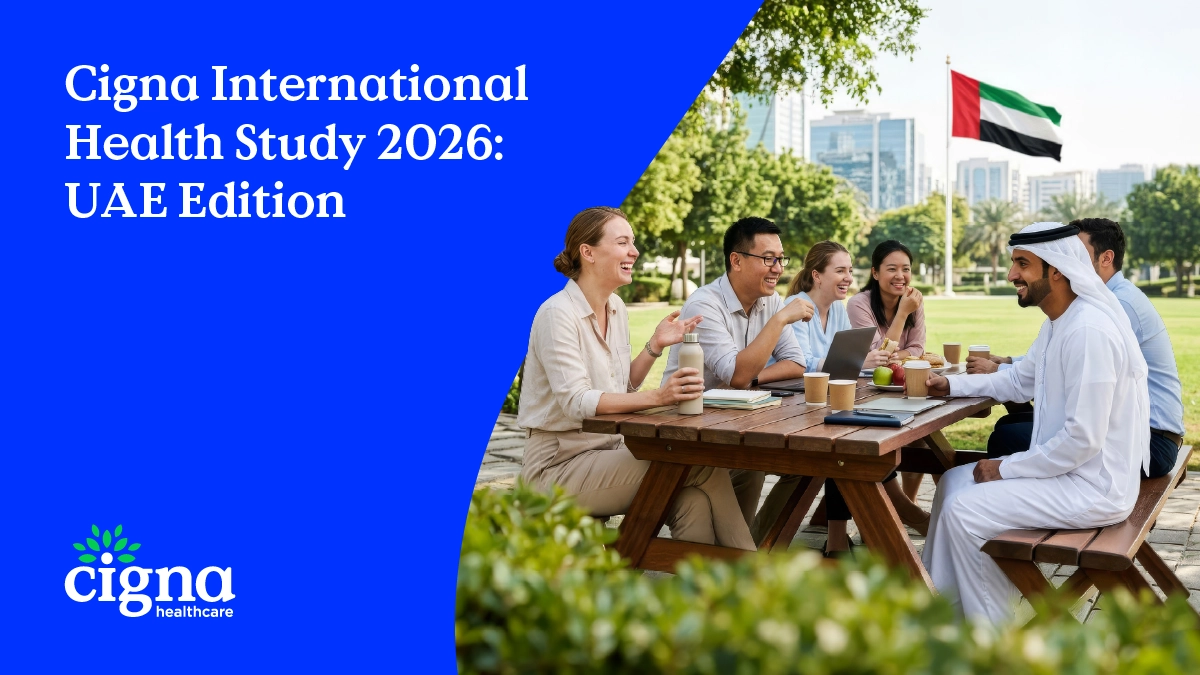
Cigna International Health Study 2026: UAE resilience remains strong, with 70% confident they can adapt to change
Cigna International Health Study 2026: UAE resilience remains strong, with 70% confident they can adapt to change
- The UAE’s vitality score rises to 73.8 in 2026
- 60% of respondents say their mental health has affected how they work in 2026
- Study identifies a clear opportunity to build on the UAE’s strong well-being foundations
Dubai, 30 September 2026: The UAE continues to demonstrate strong vitality and resilience, with people confident in their ability to adapt to change, recover from setbacks and stay committed at work, according to the Cigna International Health Study 2026.
The study, which surveyed 12,000 people across 13 markets, found that the UAE’s vitality score rose to 73.8 from 73.3 last year, while overall well-being held steady at 70%.
The findings reveal a population well equipped to navigate change. Seven in ten UAE respondents say they can adapt to change, while 69% say they bounce back after illness, injury or other hardship—both above their respective global averages. Family remains a vital source of strength, with family well-being the UAE’s highest-rated pillar at 71%.
While the overall picture remains positive, the findings also point to continued pressure on well-being. Stress affected 82% of respondents, although this is down two percentage points from last year, with the pressure particularly evident among younger adults.
Leah Cotterill, CEO, Cigna Healthcare Middle East and Africa (Outside KSA), said: “The UAE continues to stand out for its strong vitality and adaptability, reflecting the resilience and support systems that underpin well-being across the country. These are powerful strengths to build on.”
“The priority now is to sustain that resilience over the long term. Well-being needs vary across generations and stages of life, and understanding those differences will be essential to ensuring people have the right support to stay healthy and thrive.”
Employee commitment remains high
That resilience is also evident in the workplace. More than three-quarters (76%) say they are willing to work harder to help their organisation succeed, while 72% remain enthusiastic about their jobs.
Yet the wider picture of workplace well-being is more mixed. Workplace well-being stands at 52%, down three percentage points from last year, while 60% say their mental health has affected how they work. Fewer than half (49%) feel understood by their immediate manager, down five percentage points.
These findings reinforce the need to consider well-being alongside performance and engagement. Employees can remain highly committed while under pressure, making it increasingly important for managers to recognise changing needs and connect people with the right support.
Mental well-being emerges as a top priority for younger adults
The changing needs of younger adults are particularly clear in the growing importance they place on mental well-being. For 18 to 24-year-olds, mental well-being is now their top health priority, with 40% identifying it as the area they most want to improve, up 15 percentage points from last year.
This growing focus reflects a more mixed experience for younger adults across several areas of life. Their vitality score fell 4.6 points to 66.6—the only demographic group to record a decline—while mental well-being dropped 11 percentage points to 46%. Financial and workplace well-being also declined, and almost three-quarters (74%) say their mental health has affected how they work.
However, this growing priority has not translated into greater use of formal support:, with only 6% people aged 18- to 24 report receiving counselling or therapy in the past year.
The findings underline the importance of understanding what younger adults need as they establish themselves in the workforce, including how they access support and the role employers and managers can play in helping them stay well.
Making resilience sustainable
The 2026 study highlights an opportunity to build on the UAE’s strong foundations by ensuring health and well-being support keeps pace with changing needs. Priorities include earlier intervention, stronger health literacy and easier access to care, particularly where mental health and financial pressures are taking a toll.
Cotterill added: Sustainable well-being depends on people being able to understand and access the support available to them. Employers, managers and healthcare providers all have a role to play in making that experience easier and ensuring people can get the right help when they need it.”
Cigna Healthcare conducts the International Health Study to track how people’s health and well-being needs are evolving and identify where gaps in knowledge, access and support remain. The study provides insight into the factors shaping health, well-being and vitality across different markets and populations.
About the Cigna Healthcare International Health Study
Cigna Healthcare surveyed more than 12,000 respondents in 13 markets – the US, UK, Spain, Netherlands, Belgium, Switzerland, Kenya, UAE, Saudi Arabia, Singapore, the Hong Kong SAR, Japan, and Germany, from 3 july to 26 july, 2026, in collaboration with YouGov – a global public opinion and data company. The nationally representative online survey assessed the health, vitality and well-being of 1,000 adults (aged 18 years and older) in each of the markets – the US, UK, Spain, UAE, Singapore, the Hong Kong SAR, Japan, and South Korea, 750 in Saudi Arbia, and 500 adults per market in Kenya, Belgium, the Netherlands, and Switzerland.
To read the full Cigna Healthcare International Study report, please click here.
To read Cigna Healthcare International Study Infographic, please click here.
Related articles
-
Whether you wish to speak to our sales team or get general help if you are an existing Cigna member, we can get you to the right information.
- Contact Information
-
Existing Member? Login and manage your account with the Cigna Envoy® website
- Login
© Cigna Healthcare. All rights reserved.
Cigna Healthcare and Cigna HealthcareSM (Cigna Healthcare) are registered service marks of The Cigna Group and/or one of more of its subsidiaries. Products and services are provided by these subsidiaries, affiliates and other contracted companies and not by The Cigna Group. The material provided herein is provided for information purposes only and is believed accurate as of the date of publication, and is subject to change. This material should not be relied upon as legal advice. Products and services may not be available in all jurisdictions and are expressly excluded where prohibited by applicable law. The material provided herein is only a general description of benefits. Please consult your policy booklet or contact Cigna Healthcare for a complete listing of policy coverage and applicable exclusions and limitations. Cigna Healthcare does not provide medical care and cannot predict medical outcomes.